
"VILLA-DOMINGUES"
"VILLA-DOMINGUES"
Solo exhibition by Alex Domingues
curated by Bruna Fetter
"Villa-Domingues" proposes a renaming and re-signification of the social place of the Casa das Artes Villa Mimosa , in Canoas. Starting from the artist's personal history and traversing the history of the institution itself: the mansion was the workplace of his great-grandmother, Luci Domingues, who worked there as a domestic servant. Deceased before the artist's birth, Luci inhabits the family imagination through accounts and photographs, most of which were lost in the flood of May 2024. The body of the exhibition is composed of videos, a photograph on a portrait scale, and a video installation. The works articulate the material losses and the erasure of intimate memories that were submerged in water and buried in rubble in the Mathias Velho neighborhood.


CURATORIAL TEXT
by Bruna Fetter
Based on memories lost during the May 2024 flood and all its severe consequences for the city, Domingues creates interconnections between images of that moment of collective material losses, but also of the loss of intimate memories that were submerged in water and buried under rubble.
Composed of two videos, a video installation, and a small, frame-sized photograph, Villa Domingues traverses different moments in the artist's life, the life of this house, and the history of the city of Canoas. The first video, "Until when will we have a home?" (2024), starts with a static camera filming Alex's street completely flooded. A resident of the Mathias Velho neighborhood, the artist had his house flooded and his personal belongings and possessions lost in May 2024. Along with them, the memory of his family. This exhibition seeks, from this point on, not to repair or reconstruct this history, but rather to give new meaning to the role of these memories.
The central work of the exhibition is the video installation entitled, “The Material History of My Family is a Pile of Debris” (2025), which features eleven screens of different sizes and technologies, including a laptop. Of these, only five are functional. Each of these screens presents an image of what no longer exists. From noise and interference to the looped presentation on the small laptop located on the floor of the only three remaining images of her great-grandmother. This multi-channel installation allows us to simultaneously experience different places and different times, creating multiple narratives. Since these videos are not synchronized, they reappear and reappear in an eternal mismatch. Thus, each time we visit the exhibition, it is possible to perceive a specific encounter of images. And with each new visit or different moment of the exhibition, this encounter is renewed and modified, multiplying the possibilities that traverse and compose these narratives. And also multiplying the different types of reception that the public has of these temporalities.
Villa Domingues, the artist's first solo exhibition, is part of Villa Mimosa, the former workplace of Luci Domingues, Alex's great-grandmother, who worked as a domestic servant. Having passed away before her great-grandson was born, Luci inhabits his imagination only through family memories: anecdotes and old photographs. These images were almost entirely lost during the flood. Only these three survived, which, after being digitized, have been ghostlikely preserved in the data cloud.
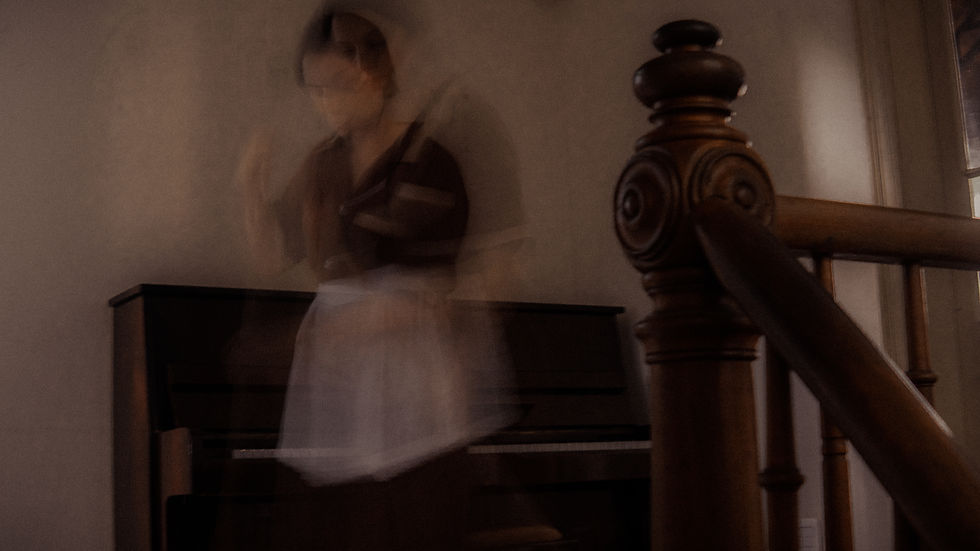
Although autofiction manifests itself in different ways in all the works, it is in the piece "My Grandfather Grew Up as the Maid's Son" (2025) that it is most evident. Filmed at the Villa, the video features an actress dressed as a maid, sweeping the patio. Referring to the absent presence of his great-grandmother, Alex presents this image, always blurred, always fleeting, always spectral. As an extension of the aforementioned video, in a corner of the room a picture frame rests on a small table, illuminated by a lamp, lending a sense of coziness and domesticity to the whole. In it, the reconstructed image of Luci reappears. A few steps away, the fiction can be confronted with the vestiges of his great-grandmother's life, who returns to inhabit this space during the exhibition period. Art meets life. And Alex rediscovers Luci in this fictional space, where almost anything is possible.



PRODUCTION
Isadora Müller
EXHIBITION DESIGN
Gabriela Frohlich
INSTALLATION
Klaus Kellermann
VISUAL DESIGN
Luciana Hoerlle
EDUCATIONAL MEDIATION
Rafaela Müller
PERFORMANCE
Andressa Matos
TRANSPORT
Eduardo “Dudu” Augusto da Silva
STILL PHOTOGRAPHY
Edson Filho
VIDEO DOCUMENTATION
Lui Apollo
AUDIO DESCRIPTION
Bruno Krieger